
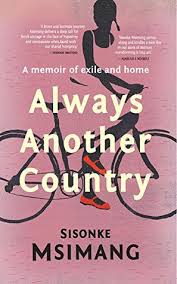
 Contrary to how it looks, I am not usually a fan of non-fiction. I reckon if I am to read something, then the last thing I wish to spend time on is reality. Reality is difficult enough to deal with; I crave escape, albeit for a few hours. Biographies are particularly not usually top on my must-read list. But, we all must challenge ourselves in this here life, so I picked up a biography.
I had been hearing about “Always Another Country”; first on a talk show, then in different magazine reviews. Thanks to the aforementioned media tour, I learned that Sisonke Msimang is the daughter to a former MK cadre, and prominent South African, Mr Mavuso Walter Msimang. As was the case with many members of the liberation struggle, the family spent decades in exile, coming back when the ANC was unbanned in the early 1990s. Msimang the Younger spent her formative years in Zambia, Kenya and Canada, with her college years being spent in the US. She is now a writer: of non-fiction, essays and political commentary.
“Always Another Country” is her account of her life: her childhood in various countries, her family, and her coming of age. One gets the sense that she left no corner of her growing up unilluminated (is that a real word?). It also serves as a tribute to her mother, being lovingly dedicated to her memory.
Msimang tells her childhood recollections of being regarded as “The Other” in Zambia, some adults being the perpetrators of segregation; of being called a monkey on the Canadian playground, by fellow melaninated children; of being seen as a ‘little privileged madam’ in Nairobi.
Msimang’s writing is polished, the book chapters succinct, more than merely holding my goldfish-level attention span. I marked several passages that had me rolling because of how deliciously witty and descriptive they were. Her literary prowess is not the only reason I enjoyed this book.
Her story is one I have been waiting a couple of decades, it seems, to read. The experience of never being at home in other countries, and of feeling like ‘the other’ in a place that is meant to be home, resonated deeply with me. I had to stop reading the book at points in order to collect myself, as it felt at times as if I was reading echoes of my own story.
Our little nuclear family spent time in North Carolina in the early 90s, in an America that was post-Zamunda but pre-Wakanda. That is, as Africans, we were ‘The Other’, and not always in a celebrated way. Children in elementary schools have no filters, and my older sister dealt with some straight-up ignorance in her time. (With South Africa’s first democratic election, and owing to some Madiba magic, my parents at least got their 15 minutes on a local news channel, so there’s that small vindication).
This experience of being “The Other” gives one empathy, which is sorely needed in South Africa. Being an outsider is no fun, especially when you are constantly reminded of it. Here I refer to that feeling of not being quite at home, at home. That feeling of somehow, by your very being, being an offense to your community, and even some sectors of your family. We South Africans tend to ostracize those who are even slightly different to the norm (think of ‘Coconuts’ with ‘Model C’ accents).
So yes, I had several “Hallelujah” moments. In many ways, it is an ordinary story of a family living in extraordinary circumstances. I enjoyed it because I could see bits of my own story reflected therein. By having told her story, she gives me a kind of permission to not gloss over my own life experiences. Her book tells me that my story matters as much as hers. That your story matters too.
It may not resonate with you in the same way, but that’s the wonderful thing about us humans. We are multi-faceted creations of the Most High God. Msimang’s life story has many layers in which you might find a fragment of your own story. Or the TTO (take-home message) may simply be a new understanding of these strange melaninated creatures amongst us who speak with different accents. We have backstories too. Until we have been a stranger in a foreign land, we cannot understand the degradation in being called any of the derogatory names we reserve for our brothers and sisters.
I will be adding more biographies to my list. What story or biography have you read that resonated intensely with you? Let a sister know.
Get your copy of “Always Another Country: A memoir of exile and home” by Sisonke Msimang at Exclusive Books. I can’t remember the price, but support South African authors.
Copyright reserved Gugulethu Mhlanga 2018
 The Treasure Chest Blog
Leave a comment