
For some reason, I have had quite the affinity for music from the 70s, for most of my life. Yes, especially the funk.
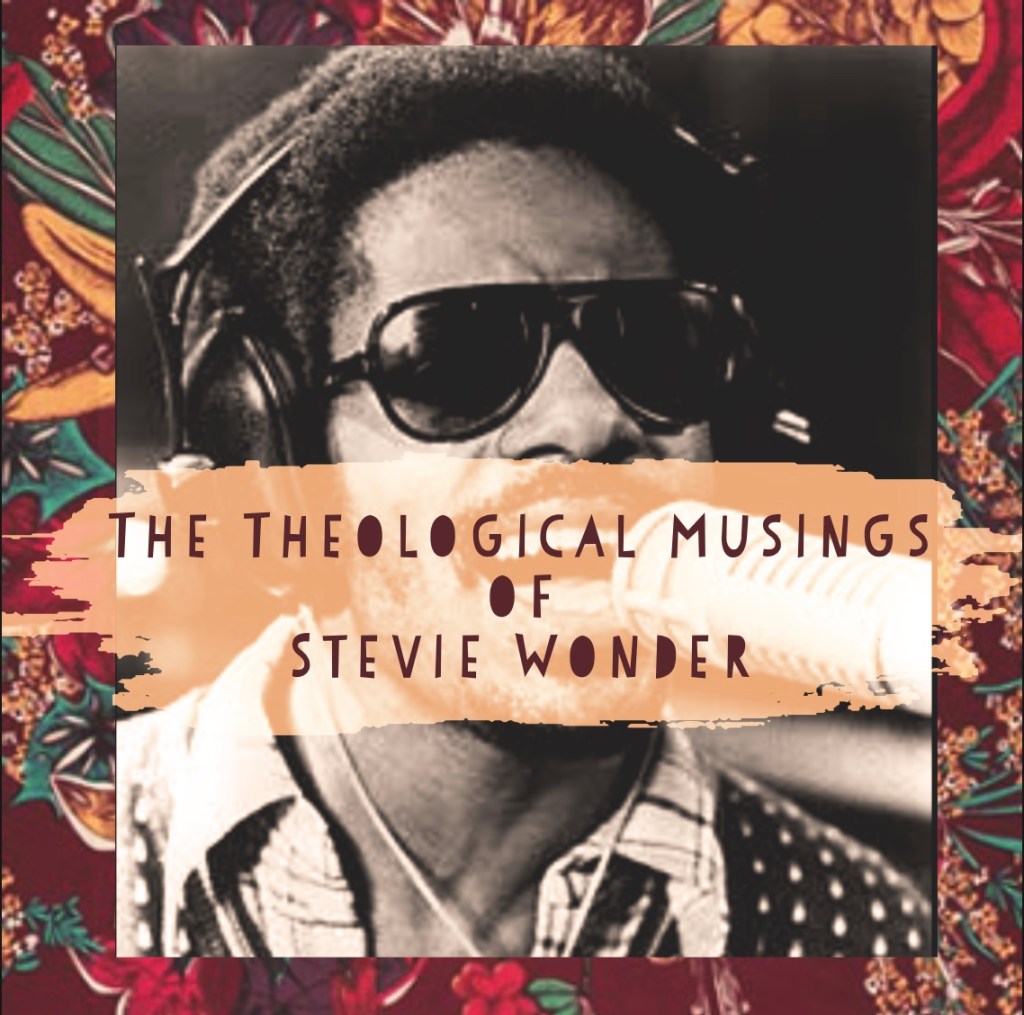
Stevland Hardaway Morris? A favourite. You may better recognise him as Stevie Wonder. His artistry, and unbridled savouring of melodies (9 minutes of “Do I Do” attest to this factoid), are a guaranteed instant mood-lifter. My mood in need of a lift, I decided to listen to “Innervisions” on my way to work one overcast November morning.
In defense of my music habits, I enjoy a wide range of musical genres, with a particular fascination for the funk-era that was the 70s. I appreciate beauty and artistry where I see and hear it.
The thing, however, about prose, art or music– including your favourite Whitney Houston track– is that one cannot go far without encountering the author’s belief system. As creatives, our beliefs, our very worldview, seep through the pens we hold, onto music sheets or canvases and into the ears and eyes of our audience, whether or not we actively intend it.
So, though I don’t stick purely to art that contains explicitly Christian lyrics and subject matter, I do try to actively interrogate the message conveyed in a good tune or movie. Either that, or I stick to instrumentals or music sung in a language foreign to me. There’s significantly less internal conflict if I happen not to understand what is being sung. I digress.
Anyhoo, back to Mr Wonder and how I never paid close attention to some of his lyrics, until that November morning. My ears finally cottoned on to some thought-provoking words in the chorus of one particular song.
Written in 1973, “Higher Ground” reels you in with a serious funk factor of wah-clavinet, a synthesised bass line, layered with tambourine top notes, and undergirded by a funky drum groove. All providing a luscious canvas for the words soon to be discussed. The lyrics, legend has it, were written in around 3 hours. This is according to an interview Mr Wonder conducted around the time of the album’s release.
“For me, I wrote ‘Higher Ground’ even before the accident…But something must have been telling me that something was going to happen to make me aware of a lot of things and to get myself together.”
Here, he was referring to a car accident, later in 1973, that had him in a coma for a spell, and left him with a partial a sense of taste.
And now, a closer look.
At first, the lyrics are neutral enough:
People keep on learnin’
Soldiers keep on warrin’
World keep on turnin’
Cause it won’t be too long.
Then that chorus.
I’m so darn glad he let me try it again
‘Cause my last time on earth I lived a whole world of sin
I’m so glad that I know more than I knew then
Gonna keep on tryin’
‘Til I reach my highest ground
With that refrain, Stevie Wonder makes a loaded statement, with profound theological implications. In case you missed it, like I did for years, he is talking about reincarnation, his lyrics suggesting that his present experience ain’t his first time at the rodeo. That is a particularly intense declaration to hit us with before your clavinet solo, sir.
“Higher Ground” lays out Mr Wonder’s view of this life and what comes next. Not surprisingly, for the era in which this song was written, he reveals a bent towards the Eastern religious ideas of reincarnation, and an ability to work your way to doing better, having higher subsequent existences, until one finally reaches an enlightened state.
But if you thought Mr Wonder’s 1973 spiritual frame of mind was as simple as dabbling in elements of Hinduism, hold on in your assessment. There’s more! On the very next track, no less.
“Jesus Children of America” contains a frankly dizzying multiplicity of ideas. Right from the start, Mr Wonder mentions the Name above all other names (the Name of Jesus) right there in the title. That’s the game changer. If you want to bring Jesus into the conversation, you do so on His terms. More on that later.
Verse 1 begins:
Hello children
Jesus children
Jesus loves you
Jesus children
Hello children Jesus loves you of America
“Jesus children” is not a random phrase. My postulation is that it’s Mr Wonder’s lyrical take on the Jesus People movement that gained popularity in the late 60s, and into the 70s. They were a hybrid churchy/hippie group, who felt the need to reach out to the disenfranchised youth of the time. Indeed, he addresses them in verse 2, asking if they are hearing what they’re saying and believing what they’re praying. It could be a dig at the group. I can find nothing to support or refute my supposition.
The third verse goes on to address “Holy Rollers”, most likely a reference to those in the mainstream Church, in an admonishment to practice what they preach. Another dig. Mr Wonder had a problem with religion. Again, not surprising for the era.
The next verse references transcendental meditation, I suppose Mr Wonder’s solution to life and the pursuit of peace.
Transcendental meditation
Speaks of inner preservation
Transcendental meditation gives you peace of mind
Next verse: a conversation with a drug abuser. Reminding him that Jesus died on the cross for him, and that (Jesus’ mother) Mary is looking at him (a beatific gaze from a cathedral of some kind, perhaps). The verse serves to remind the drug abuser of the literal dead end of his/her addiction.
Talk. About. A 180-degree shift.
Threaded through the song, the refrain:
You better tell your story fast
And if you lie, it will come to pass
(Can’t help you decipher that one).
The whiplash. To be fair, I do not think that Mr Wonder meant for either himself or his song to be viewed as a repository of answers as it pertains to the hereafter. What is evident, however, is the general confusion, seeking and grasping. There is much fodder for discussion. Perhaps it will help us to consider the era.
In short, it was a time of socio-political chaos. In the preceding decade, John F Kennedy had been assassinated (1963), hippies and free love (that is, VD free-for-all) and Woodstock (1969), Martin Luther the King was assassinated (1968), the civil rights movement was at pitch, making its largest legislative gains in the 60s. The Jesus People Movement began, perhaps a response to the concept of ‘free love’ (1967). Drugs were de rigeur, inspiring visions and songs (Lake Shore Drive was probably really about LSD; let’s not get started on the lyrics of Hotel California). To say the people were looking for an answer, a reason to all of the chaos, is simultaneously accurate and understated.
In an America that had (according to the propaganda) been founded on Judeo-Christian principles, the unsettledness of the 60s and 70s found ‘traditional’ Christianity stifling, the rules of it creatively stifling. Or perhaps man was being man, and trying once again to reach for godhood. The idea of breaking off the shackles of tradition, and determining good and evil for the self. Sound familiar? *Ahem*Garden of Eden*
Enter spiritualism. A lot of the creative set found seeming freedom in exploring religions of the East: Hinduism, Buddhism, Taoism. The Beatles left behind the clean-cut image, grew their hair out and consulted gurus at retreats in India. Mystics were the new super-celebrities, guiding our regular-degular stars to supernova status (tongue-in-cheek). Transcendental meditation, as a path to spiritual wellbeing, became popular.
Fully exploring the allure of Eastern religions as an alternative to traditional “rigid” Christianity, would be another topic altogether. But briefly: celebrity is about self. Elevating oneself. Christianity, true Christianity, points back to Jesus. If it doesn’t point back to Jesus, and specifically to Jesus as Lord and Saviour, then…
So, it becomes plain to see how a worldview that elevates self as the highest good, is so easily embraced by those who look to fame as a source of significance. But I digress.
Stevie Wonder.
In 1973, Stevie Wonder crafted that “Innervisions” album against this cultural backdrop of religious curiosity and rebellion against traditional Christianity. And Mr Wonder was himself at least curious about different forms of spirituality. All well and good. And on a popular piece of music, it really is the artist’s choice.
But he brought my Lord and Saviour into the mix. Now we step out of possibilities and alternatives, and into the realm of Truth. With a capital T. Jesus is not an artistic idea, that we can mold to fit our own desires (Lord knows we all try to sometimes). When we start talking about Jesus, we need to take Him as He is, and as He reveals Himself in Scripture. In those Scriptures, He makes some boldly exclusive, and absolute statements about Himself. Statements which preclude the notion of alternatives. He is not an alternative way to reach the nebulous goal of “Higher Ground”.
Back to the songs and ideas put forth by Mr Wonder.
Let us indeed start with the idea of reaching Higher Ground through coming back (to earth) and doing better. We can’t.
Firstly, because we won’t be coming back.
“Just as people are destined to die once, and after that to face judgment, so Christ was sacrificed once to take away the sins of many; and He will appear a second time, not to bear sin, but to bring salvation to those who ae waiting for Him.”
-Hebrews 9:27-28.
Secondly, we can’t do better. We are incapable of doing enough, because we are all born into deep trouble. We are all fundamentally sinful and offensive to a Holy God. Not my handwriting. This is according to the Word of God that Jesus embodies. John 1:1-15. Remember, Mr Wonder himself brought Jesus into this mystical conversation. I’m just reporting what God’s word says about Jesus.
According to that Word,
“All men have sinned and fallen short of the glory of God.”
-Romans 3:23-26.
And the deep trouble to which I alluded, is that
“The wages of sin is death, but the gift of God is eternal life.”
-Romans 6:23
(That but is why they call this the Good News).
At the risk of using a cliché, a gift cannot be earned. And as good as a gift might sound, it tends to sit ill with us humans, as it messes with our pride and temptation to be masters of our own destiny.
Ideas about mankind’s purpose and reason for being, as well as our eventual end, are myriad but similar. Mankind tries to find meaning in self, and imagines that self is the greatest there ever was or can be, and that self is capable of his /her own salvation. Self does not need God; self is god. But, you know, live YOUR truth. As for transcendental meditation, it is touted as a way to connect with our highest selves, and realise our godhood, our oneness with the Universe.
We cannot be God. We are humans, created in His likeness, certainly, but we are not Him, and we never will be. As for the universe, as gloriously and beautifully as the universe was designed, and set into being, it is still a created thing. God is the Creator of the universe. Ultimately, we yearn for our Creator to.
Jesus stands in stark contrast to the idea of mankind earning our own redemption. He says He is The Way, The Truth and The Life (put some capital letters on that). No one can come to the Father (God), but through Him (John 14:6). He came as the perfect sinless sacrifice to purchase mankind’s ransom. He is our salvation. Our only salvation. To get to God, we go through His Son, Jesus. We cannot get to Him by our own enlightenment or virtue, not through transcendental meditation, and not through doing better the next time around. Only Jesus.
I don’t know where Mr Wonder’s current theological musings lean. I hope he is blessed enough to have realised the shaky ground of believing in any path to salvation other than Jesus Christ as he is revealed in His Word.
I hope you, dear reader, are too.
Copyright reserved. Gugulethu Mhlanga 2020.

 The Treasure Chest Blog
Leave a comment