
Twelve years and twenty kilograms ago, I had the slightly unhinged idea to embark on an adventure uncommon to South Africans. While others were dreaming of destination beach vacations to Zanzibar or Bali, I decided: Samoa.
Why? I’m glad you asked. Travel back with me to the year 2011.
You see, for some unknown reason, I had been bitten by the Super Rugby craze. For those who don’t know, Super Rugby is a trinational club rugby contest, showcasing the best club rugby of South Africa, New Zealand and Australia. A total of 15 teams (in 2011) vied for prime bragging rights. The competition on and off the field was intense. Workplaces ran Super Rugby betting pools. Families and communities were divided and friendships torn asunder for those 21 weeks. (Okay, maybe it wasn’t that deep, but there were a significant number of Pêreliete[1] from the East Side who were staunch supporters of New Zealand teams. And only New Zealand teams.) Fridays and Saturdays were spent catching matches on TV and mobile devices. Braais were organised just to discuss and view said matches. Added to that, 2011 was a World Cup year. And I was eagerly watching ALL the rugby.
Because of the Polynesian brothers.
Guuuurrrl. Dwayne ‘The Rock’ Johnson had some foine cousins out there in the rugby streets. So I decided: let me go to the Origins. That’s how I ended up booking my little vacation to Samoa.
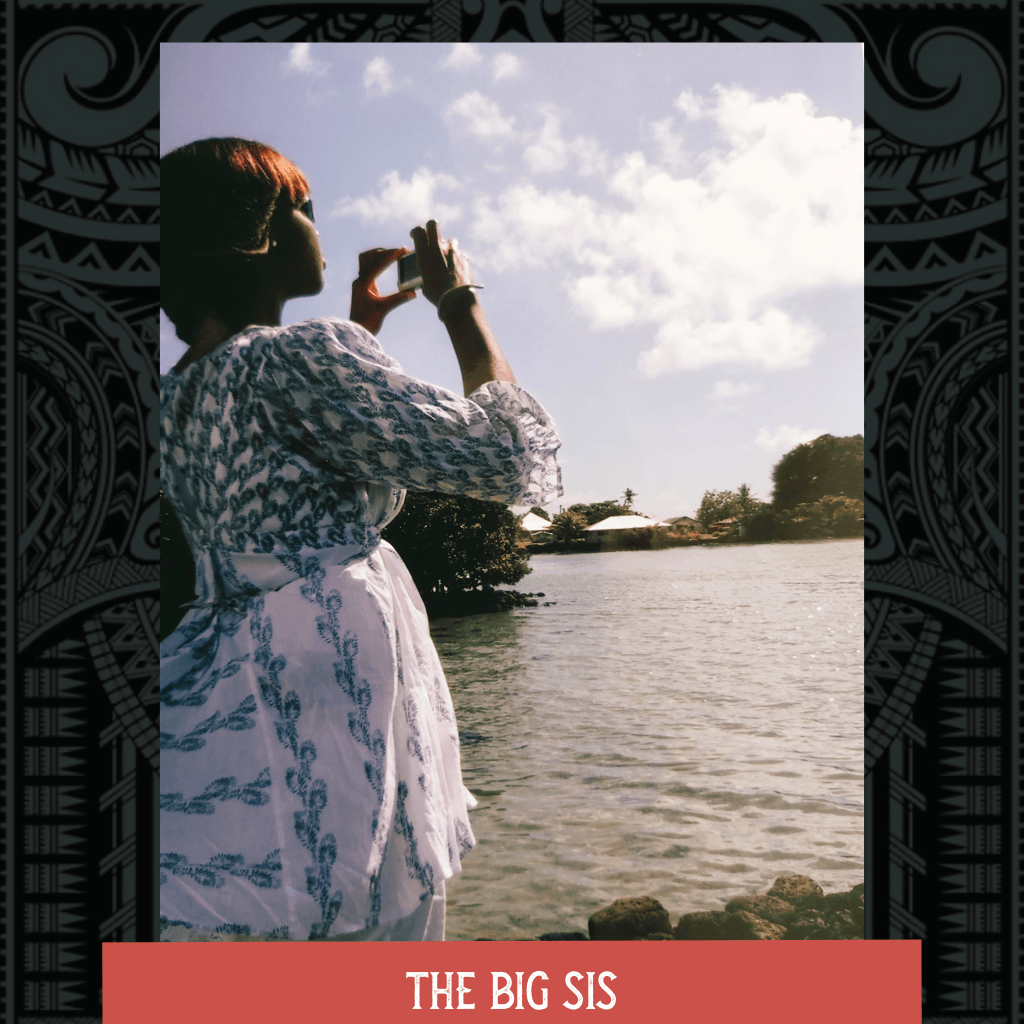
I somehow roped The Big Sis™ into my madcap plans to traipse across the globe (pray for my sister, y’all. She has me as her little sister). On one fine day in October, after approximately 6 months of planning, we boarded the 13-hour Qantas flight to destiny. Well, maybe not destiny, but certainly Australia. Another 6-hour flight, and we landed at Faleolo Airport, 35km outside of the capital city of Samoa, Apia.
Our visit was unfortunately timed, as the Springboks had just eliminated Manu Samoa (the national team) from the World Cup, barely a week prior to our long-anticipated trip. Anyways. My slight trepidation was unfounded. We were warmly welcomed.
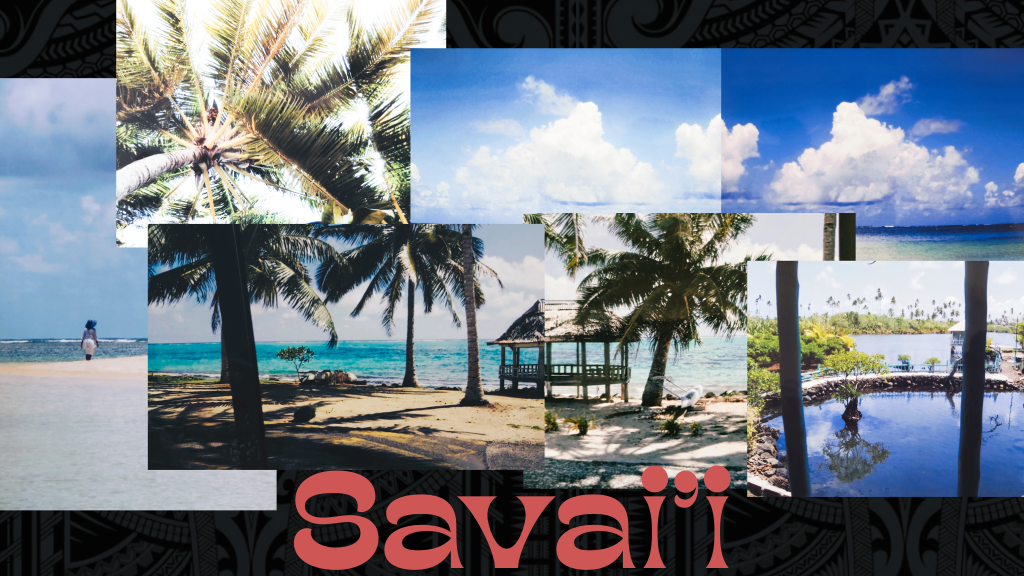
Samoa is a nation of 2 volcanic islands (Upolu to the south and Savai’i to the north), so you know it’s all things lush and green and fertile and beautiful. Aside from the pristine azure waters, and colourful buses (reminiscent of those brightly festooned Durban ones), 2 things remain etched in my memory.
- It. Is. Humid. Extremely. For context: imagine Durban in the summer (Americans, insert Washington D.C. here). Samoa = (Durban x Washington D.C.) to the power of 3-humid. Disembarking from the plane, we were met with a solid wall of heat and moisture. At 6 in the morning. Humid.
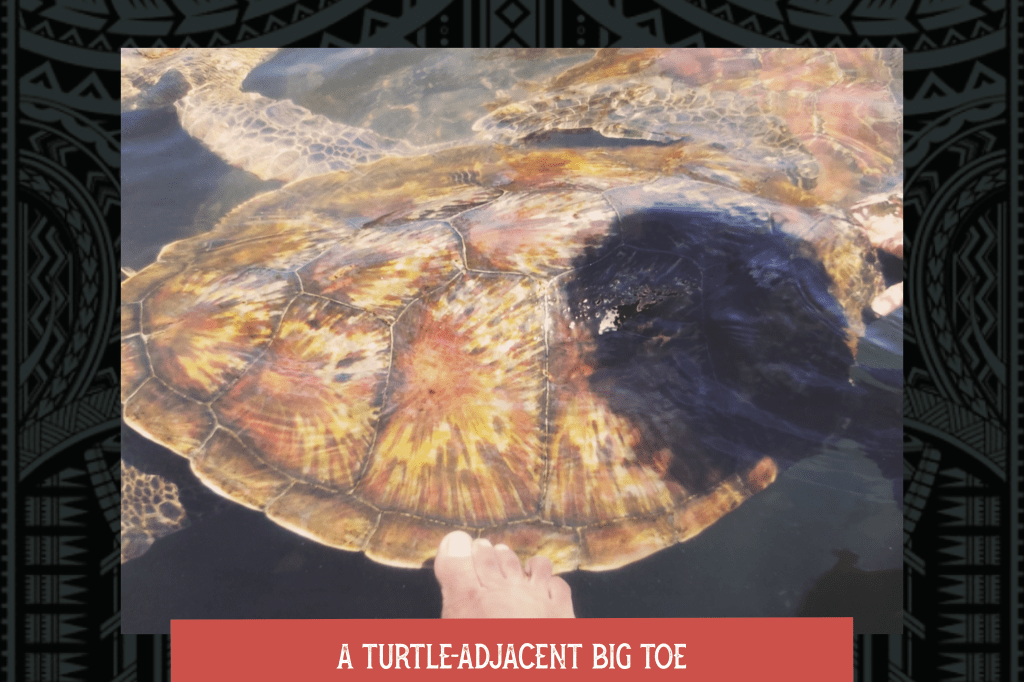
- Savai’i, the northern island, was unforgettable, and not only for the sea sickness I experienced on the ferry. The beauty! Add to that, our excellent tour guides provided rich historical and cultural context to the sights. Futhi[2], we swam with the turtles in a lagoon-type sanctuary (well, I dipped my big toes in), drank coconut water straight from the source, walked with the fishes (in the shallows, of course), etc.
One of our tour guides (we’ll call him K[3]) was the proud owner of several tatau (the Samoan word from which we derive the word ‘tattoo’), including an impressive looking pe’a. A pe’a is a man’s traditional (and rather extensive) tatau, typically stretching from the hips to the knees (both front and back). When finished, it resembles a pair of tights, so densely tattooed the skin can be. The feminine version is called malu, less dense and extensive than the pe’a.
Tatau hold deep significance for the people of Samoa, and represent community, power, status, respect and honour. They are a mark of pride only to be worn by Samoans[4]. Each tatau speaks to the recipient’s family history, accomplishments and responsibilities. Because they are specific to the recipient, no two people will have the exact same tatau. It is believed that the pain of receiving tatau brings the recipient closer to their forebears who have undergone the same ritual, and creates an inseparable bond with one’s family[5].
To hear K tell it, being adorned with a pe’a is a choice that each man makes for himself. As I understand, it is not forced upon anyone, but is a ritual bridging the transition from boyhood to manhood. In fact, there is no shame per se in not having tatau; you’ll just be known as telefua or “naked”. Those who wish to get tatau are asked several times if they truly wish to proceed. Better to choose not to even have a tatau (telefua), than to start and give up before the end of the process. THAT would bring the dishonour of being known as pe’a mutu[6].
Back to K’s story.
There came a time in his young adulthood when K, too, wished to embark on that process. He was duly asked by his community, several times, if he was certain. Each time he was questioned, was an opportunity to back out if he wished to. A chance at an honourable exit, as it were. He decided that yes, this was what he wanted.
And so began a 6 week-long stretch of near-torture (K’s words, not mine).
Now remember, Samoa is HUMID. The only physical relief from the heat was the breeze blowing through the fale[7]. The only mental relief from the impending pain, was the women singing songs to distract him. The tatau process started with K lying on his stomach, with assistants holding down his arms and legs. The tufuga ta tatau (master-tattooist) set to work with his ‘au (a boar-tusk comb), carving the ink into K’s flesh, tap by tap. There was pain, excruciating pain. There was blood. There was the risk of infection[8].
After 5-6 hours, at the end of that day’s session, he was helped into the (salt-)water to wash off the blood. (Salt being a convenient natural anti-septic, never mind that it burns like all get out). Whatever sleep was to be had that night was on a grass mat, which would get stuck to the open wounds. Aforementioned grass mat would be peeled off the scabbing wounds in the morning, and he would be dipped in sea-water again. Next session, the tufuga worked on the next section/design. Rinse and repeat for 12 (twelve!) sessions. And 6 weeks.
At some point, K said, he could barely move without assistance, each movement bringing to mind the scorching depths of Hades (my words, not his). His traumatised skin was at various stages of healing, everything from fresh painful ink to inflamed to scabbing and itchy. The process drove him to depths of melancholy never experienced before or since. He wanted to stop, but couldn’t. Because, you know, dishonour. But he finished, y’all! That pe’a was impressive, and remains a testament of his endurance in artform. He, at last, could also be referred to as soga’imiti[9]. The level of respect from his community for finishing the ritual made it worthwhile. His words, not mine.
After The Big Sis™ and I picked our jaws off the floor after that account, it got me thinking. And those thoughts have stuck with me all these years later. (Also, I will never ever look at tatau the same way again).
K’s explanation of his sober-minded decision to receive his pe’a, reminded me of a Word I had read in The Word.
Luke 14, to be exact.
Jesus had a large crowd following Him, a much larger crew than just his 12 disciples. It was probably a mix of some who believed that He was the Messiah, others who wanted to use His words against Him, and yet others who were merely curious about the miracles He was doing in these streets. Scripture says He turns around and starts speaking with the crowd.
By using several illustrations, Jesus sketches out what being His disciple truly means (I can just imagine Him: “Listen, I need y’all to understand something about following Me.”).
In verses 28 to 30, He says:
“For who would begin construction of a building without first calculating the cost to see if there is enough money to finish it? Otherwise, you might complete only the foundation before running out of money, and them everyone would laugh at you. They would say, ‘There is the person who started that building and couldn’t afford to finish it!’”
Contrary to many messages preached nowadays, that pose Christianity as some gateway to health and wealth, Jesus is doing everything BUT promising ease. In fact, it is almost as if He is trying to dissuade those in the crowd from following Him. He says to them that to be His disciple, is to love Him even more than your nearest and dearest, yea even yourself. It is to carry your cross, putting your life second to obedience to Him. It is to count the cost and decide if you reeeeeaaaaaalllly even want to start.
To be Jesus’ disciple is to give up everything for Him.
He’s upfront that believing in Him will cost us something. The call to believe in Christ for our salvation, is not just to one day escape judgement and an eternity in that place of punishment, hell. It is to follow Him as we live now, and to be shaped into His likeness.
Now, I gotta testify, y’all. For a long time, I believed that being a follower of Jesus would somehow grant me an easier life. I obviously had not read my Bible thoroughly enough. Today, I know that the idea I held is a form of transactional religion, a close cousin of the (false) prosperity doctrine. A straight perversion of the gospel. Let me explain.
In short, my internal dialogue (the silent part) went something like this: I believe that Jesus is my Lord and Saviour. I’ll be good, and follow His commands (translated as rules in my head); then He’ll see that I’m good, and will reward my obedience with good health, financial ease, a foine husband with a fine face and muzcles, minimum 1.87m tall, and cute children. Heavy on the finety.
I know what you’re thinking: that started off okay, and then it took a weird turn. But, that was the essence of my expectation in this transaction that the Lord never co-signed. Promises that Jesus never gave me, not nowhere in His Word. (We thank God for shattering that illusion.) But! He did promise me the gift of eternal life and a relationship with Him.
Jesus Himself is that surpassing Treasure worth having above all else; a Treasure that is freely offered, but that carries a high cost: to be His disciple.
In other words, His “Come as you are” is not an invitation to “Stay as you are”.
And so, along with the invitation to Himself, He lays out that life will be guaranteed to be hard at times. He doesn’t allow us the luxury of a half-committed faith tailored to our own comfort. He offers salvation on His terms, and under His Lordship. If, instead, we think we can state our own terms, it’s not really Him we serve (amen?). To borrow from the illustration of the pe’a, we are naked. Worse, we are pe’a mutu.
The sober mindedness with which bakwaSamoa[10] take the decision to begin the tatau process, has my utmost respect will always serve to remind me of the Gospel.
As a mzakes[11], it is but a glimmer of the sober mindedness with which I take the decision to believe on Jesus and to follow Him, AND a reminder of the daily decision to die to myself and my desires and live for Him. Bazakes, this is something I have to re-examine constantly. Have I counted the cost? Am I willing to do what He says I must do, and say what He says I must say? Am I willing to let the Master painstakingly etch His design into me, body, soul and spirit?
As we begin a new year, let these questions never be far from our hearts. The Way will be hard; that is a guarantee straight from the mouth of Jesus. But the Holy Spirit will give us the grace to truly be His disciples.
Be encouraged, fam.
Let the church say…
Copyright reserved. 2023 Gugulethu Mhlanga
[1] Dwellers of the town of Paarl, Western Cape, where I worked at the time.
[2] Futhi: on top of that (in this context)
[3] This was 11 years ago, I have no way of asking K whether he would want his name in this, so initial it is. Also, he shares the story of the pe’a with all his tour groups.
[4] Appropriators, beware. I would not want to insult a Samoan.
[5] Source: http://www.americanaiga.com
[6] Insert judgemental African aunties sucking their teeth: “Look at you, walking around with a half-finished tattoo.”
[7] Fale is a traditional wall-less thatched hut, the roof of which is supported by pillars, to allow maximal exposure to the breeze.
[8] K shared how two of his friends had sadly succumbed to complications following the ritual. One demised from severe blood loss, another demised following the onset of infection. Not for the faint-hearted.
[9] The opposite of the naked man.
[10] bakwaSamoa: the people of Samoa
[11] Mzakes/Bazakes: a colloquialism denoting Christian/Christians.

 The Treasure Chest Blog
Leave a comment