
27 April 1994 was a monumental day. The culmination of Black South Africa’s struggle for freedom and self-determination in the land of our birth. The first real election in South Africa: all citizens over the age of 18 were finally given the right to vote. Or rather, the right to vote had been fought for, protested for, and had at long last been won. Lives had been sacrificed in the battle for that right. A right, might I add, that others had been afforded at birth on the basis of skin colour/demelanination[1].
I had just turned 9. American news stations were running stories about how our Mzansi (South Africa to them) was preparing for the elections, with the requisite alarmist field reports for a world awaiting peri-election blood-shed. South Africa was BIG news. I didn’t know how big, until news reports came knocking at the door of our apartment in Chapel Hill, North Carolina (Tarheels!!!!).
I need to pause here.
The late 80s and early 90s were a peculiar time in history. And I’m not talking about the profusion of denim, the garish technicolour tracksuits or the massive hair. It was peculiar in that, I have yet to see the level of worldwide, sustained mobilisation around a single issue, as took place in that era regarding Apartheid South Africa. And this before the time of social media.
University students in many countries organised massive protests, demanding “Free Mandela!”
Musical artists from around the world joined in creative protest. Remember the Eddy Grant song Gimme Hope, Jo-anna? That was floridly anti-apartheid. Uncle Eddy didn’t even try to disguise his criticism of the blood-thirsty apartheid regime. The song was HUGE. The South African government banned it, but that didn’t stop us from hearing the catchy melody and singing the lyrics. (Of course, I didn’t really know English at the time, so who knows what I actually sang). Other songs were banned, which was on-brand for an oppressive regime that had ensured the exile of the talented and outspoken artists birthed on South African soil.
With apology to Gil Scott-Heron, this revolution was eventually televised. At least, the final years of the revolt against apartheid were displayed for all to see. Those who saw had a choice: to either turn away, or to act. History repeats[2].
Then.
On 11 February 1990, Nelson Mandela was released. Nelson Mandela, the man whose name had been sung by us children in the struggle songs we sang in place of the usual nursery rhymes[3], was finally released from Victor Verster Prison[4].
All I remember about that day, is that the adults (my parents and them) had coincidentally (to my mind) gathered for a braai and to watch TV together. Of course, now that I think of it, they must have been gathered because the entire (black) country was holding their collective breath to see if the apartheid government would uphold their decision to release him.
Walk free, he did. With Mam’Winnie Mandela. Like a boss. {Note to self: insert picture of THAT walk}.
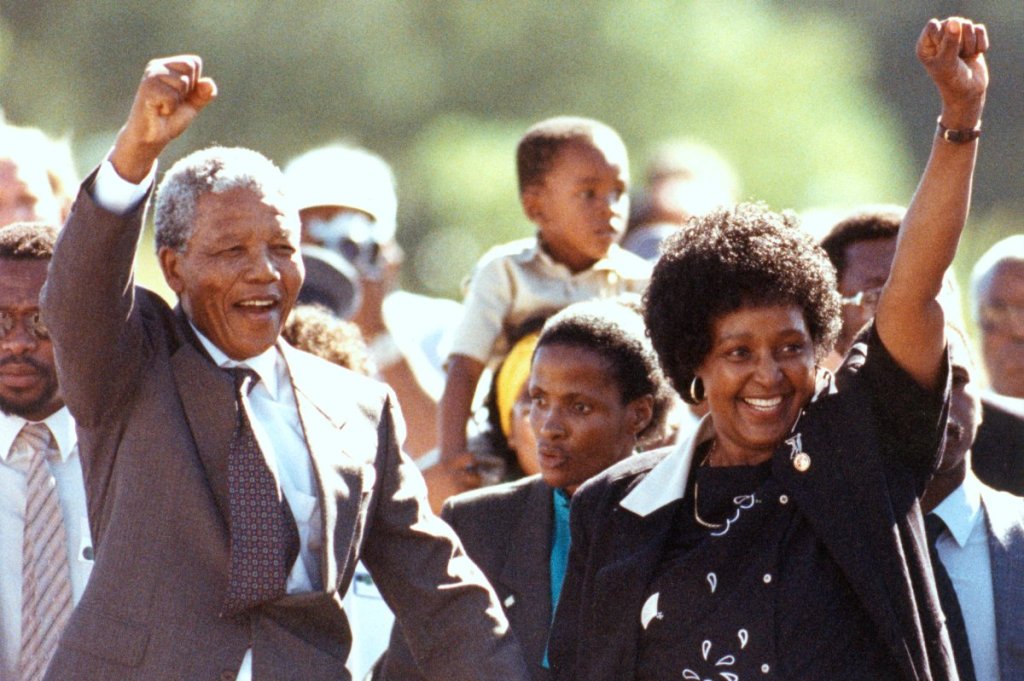
Nayi le walk
Bazakes, did we not all toyi-toyi around the hospital grounds and into the community. Us children were running at the front of it all. I was all of 5 years old, at the time.
Back to the news reporters.
It so transpired that my mom received an opportunity to do her Masters degree in North Carolina[5] from 1992. Dad decided that he too would undertake the same program. The Big Sis™ and I went along for the ride.
I don’t have many memories of that time between 1992 and 1994, as it pertains to the developments in the home country. I only found out later, in my subsequent viewing of documentaries of that era, that the official end of apartheid required much negotiation. CODESA happened. Proponents of apartheid staged coup attempts. Political parties were unbanned. More liberation stalwarts, jailed for their anti-apartheid activities, were released.
And more bloodshed: Chris Hani’s life was cut short in an assassination at his home. On a Sunday morning.
The threat of civil war hung heavy over the land, even as Hope’s heartbeat grew stronger.
There were pockets of violence and bloodshed fomented by political and tribalist factions, in KwaZulu in particular.
Hope hung on by a thread.
But the world was sitting on apartheid South Africa’s neck. It had dawned on the previous supporters of the National Party Government, that perhaps the tide was turning against their friends, the segregationists. They (the supportive governments, that is) were dealing with that groundswell of (largely student) protest against that unjust regime. And so, they had imposed economic sanctions[6] on South Africa. With The Bag being threatened, apartheid South Africa was more receptive to ending centuries of colonisation, decades of segregation.
The date for the first free and fair election was set: 27 April 1994.
The Big Sis™ and I had a backseat view[7] of our parents’ first election. Dad was 40 years old. Mom was 36. They were grown grown before being allowed, in the country of their birth, to vote as citizens of the land[8].
Except, we weren’t in the country of our birth. We were in the United States of America.
Reporters came to our door, having planned to compile a news report on black South Africans, living in America, who were voting for the first time. Dad and Mom went to the voting place in the Buick, with the reporters tagging along in the news van. It was a few days before the vote in South Africa, as is protocol. And that is how Mom and Dad’s first election was televised on the local news in Chapel Hill, North Carolina. I know famous people, y’all.
We came back to brand new, racially integrated South Africa later that year. Looking back, those first days of the Rainbow Nation were heady and euphoric. Were we in delusional denial of the hard work soon to come?
A bloodless regime change, they called it. It was anything but bloodless. But we slapped the Rainbow Nation Band Aid on it and started to call this nation a new thing.
Healthcare and nutrition, education, and economic growth were on the agenda. The country was off to a hopeful start. We could conquer the world. And we even won a World Cup on the strength of Madiba Magic. Rainbow Nation! Bottle it and sell it.
Euphoria cannot be sustained. Alas.
I voted for the first time in 2004, at the age of 19. I do not remember anything momentous about that day. All subsequent elections have been devoid of the fanfare of that first election. All of them. The same difference, I imagine, between the excitement of a wedding day versus the grind of everyday life in a marriage.
Every 5 years the sparkling lights come on, the showmen take the stage, and promises are made. A kind of toxic 5-year renewal pageant.
But where are we really?
We’ve had 5 presidents since 1994. The whiff of corruption has become increasingly strong. The word ‘tender’ carries a nefarious connotation in our beloved country. The National Treasury has somehow become a source for the personal enrichment of certain individuals, but no one can ever trace the path by which the funds leak out of the public purse.
Key points of infrastructure have failed to keep up with the growing demands of the land, despite a regular census aimed at monitoring population growth. Again, nobody can give a satisfactorily transparent answer to how we got here. And more loadshedding to you, too.
Speaking of the population: health care. From the deadly HIV/AIDS and TB twins, to a regression in gains made against teenage pregnancy in the early 90s, to the recent panini of 2020, our healthcare infrastructure has taken a beating.
Education experts have raised many alarms at the dubious rates of literacy of South African minds, young and old.
Economists and citizens decry the rampant rates unemployment, as well as the ever widening rich/poor divide.
And ever present in every South African resident’s mind[9], the spectre of violent crime lurks and strikes, snuffing out many lives. So. Many. Lives. Lost.
And the blue lights turn and turn.
Kuningi. It’s a lot.
In the 30 years since “The Dawn”, we have faced an onslaught of evil realities aimed, I believe, at extinguishing our hope.
It wasn’t long into the new South Africa when some took the decision to exchange their citizenship of this country for another. For various reasons. My intention in mentioning this is not to judge.
I will not deny, however, that I am deeply affected as a citizen, when other citizens choose to leave. It means there are fewer of us remaining in the fight for the future of South Africa. It chips away at the hope of we who remain. Especially when things seem to decay despite our democratic participation.
But still I vote. Too much blood was shed for me not to vote.
I implore you, dear reader, to consider that as much as we have an enemy of our souls, that same enemy brings death and destruction to our nation.
For “the thief comes only to steal and kill and destroy; I have come that they may have life, and have it to the full,” said Jesus[10].
As a believer in Jesus Christ, I know that as much as the crime, corruption and theft in this land are carried out by real humans and their greed, ultimately “we are not fighting against flesh-and-blood enemies, but against evil rulers and authorities of the unseen world, against mighty powers in this dark world, and against evil spirits in the heavenly places[11].”
The enemy is after our hope in better: a better future, a better South Africa, a better cabal of leaders.
In the words of Jackie Hill-Perry, “Cynicism is easy. It doesn’t take effort to see what’s wrong with everything and everyone…Hope, however, is difficult. Maybe because it’s heavenly.”[12] She goes on to quote another source, by writing, “Hope allows us to go on with living. It gives us some sense that things are going to get better. Life will improve, and the problems besieging us will reach some stage of resolution.”[13]
And also, more crucially, the enemy is after our hope in the Living God. Our hope in the Lord, bazakes, strengthens us for the fight ahead.
Make no mistake, the world is evil. There are many evil things happening right here in South Africa. We have to daily make a choice. Do we despair at ever seeing a change, and a reversal of this decay? Do we succumb to apathy, and the belief that our beloved country is doomed?
Or, do we hold on to our faith that we serve a God who can turn things around? The same God, by the way, who did what the world thought was impossible in 1994.
Can we hold on to hope, and work towards the better South Africa we envision? The South Africa we hoped for back in 1994?
That being said, ultimately every man-made system is flawed to some degree. We are reminded in the Word countless times, not to place our hope in man, but to hope in the Lord. Those who hope in the Lord, “will renew their strength. They will soar on wings like eagles; they will run and not grow weary, they will walk and not be faint.”[14]
If we do nothing, nothing will change. Ordinary South Africans fought over many, many years for the freedom of all South Africans. Many ordinary South Africans can change the trajectory of this nation. We need to hold on to that hope.
This is my impassioned plea, my dear fellow South Africans, in my little corner of the Internet, to let your voice be heard in the election, and in many different ways in the years between election cycles.
And may the God of hope fill you with all joy and peace in believing, so that by the power of the Holy Spirit you may abound in hope.
Amen. And Amen.
And go vote.
Copyright 2024 © Gugulethu Mhlanga. All rights reserved.
[1] Our fellow humans of the Caucasian persuasion. Due to the fundamental nature of apartheid (segregation according to skin colour) I am not quite sure how to concisely describe, in this essay, the transition from oppressors, to fellow citizens, to co-labourers in the building of this nation. It’s been complicated.
[2] Shades of the Middle Eastern conflict.
[3] We were conscientized early. We didn’t stand a chance. True story.
[4] It was the only reasonable response, when we had to look at Jan van Riebeeck of 1652’s face on our ten rand bills.
[5] Chapel Hill was the home of the oldest state university in the USA. Also, the university team that fostered a young Michael Jordan’s prodigious talent pre-Chicago Bulls. Again, I say: TARHEELS!!!!
[6] Various sanctions began in 1959. UK and US fiiiiiinallly joined the economic sanctions party by the late 1980s
[7] From the back of a very smoky Buick. It’s a long story.
[8] Because, the government of the time diminished black people, to various degrees, to children. Elderly men and women, the repositories of wisdom and life experience, were called “boy” and “girl”. Praise the Lord that we are no longer there.
[9] We, the law-abiding.
[10] John 10:10
[11]Ephesians 6:12
[12] Jackie Hill-Perry, Upon Waking: 60 Daily Reflections to Discover Ourselves and the God We Were Made For (B&H Publishing 2023), 171
[13] Dan Allender and Tremper Longman, The Cry of the Soul: How Our Emotions Reveal Our Deepest Questions About God (Colorado Springs: NavPress, 2015), 167.
[14] Isaiah 40:31
 The Treasure Chest Blog
Leave a comment