
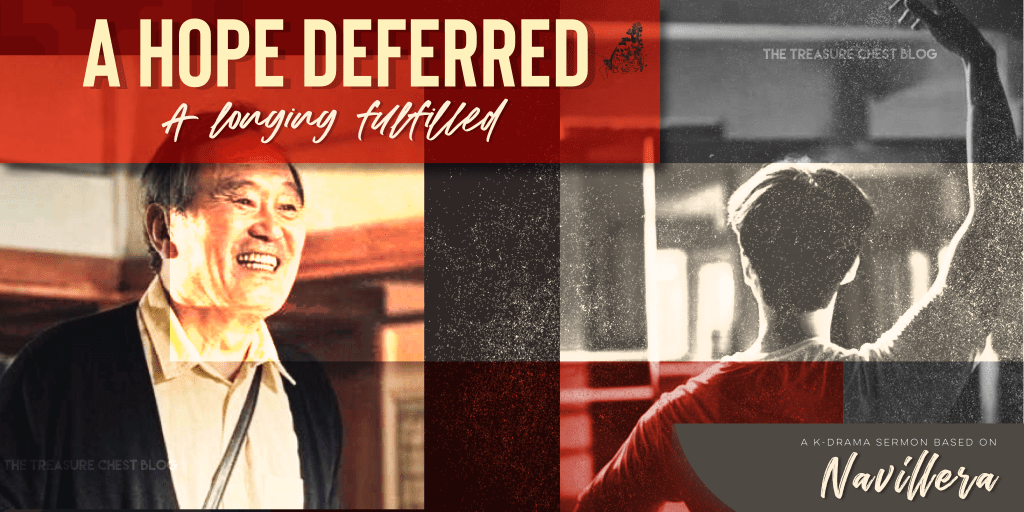
Hope deferred makes the heart sick, but a longing fulfilled is a tree of life. Proverbs 13:12
Navillera is a 2021 drama starring Park In-Hwang and Song Kang. Fret not! It isn’t your regular, stereotypical K-romance with requisite pretty faces gazing at each other longingly for 5 minutes every episode (Long Lingering Looks™).
Rather, it is the gentle tale of a man deciding to finally pursue a life-long dream, and how a longing fulfilled breathes new life into his winter years. It is a love letter to the beauty and brevity of life.
It is also the story of found family, of how a young man finds a friend, mentor, father figure, in an old man wanting to live out his dream. But more about that later. Maybe.
Shim Deok-Chul (played by Park In-Hwang) is a 70-year-old father to 3, devoted grandfather to 1. He has lived his whole life as a civil servant—a mailman, to be precise. It was tough providing for his family during South Korea’s economically lean years, but he and his wife managed. Now, in his retirement, he and dichinggu[i] live to gather once every month or so. Sometimes to play chess, sometimes to bid farewell to one of their number, always to swap notes on new ailments and corporeal complaints.
During one of their chinggu’s funerals, one of the friends wonders why he no longer feels like crying at funerals. Deok-Chul halabeoji[ii] answers, “As we get older, we get used to goodbyes.” A sombre reminder of man’s mortality.
On his way home from the funeral, Deok-Chul halabeoji is stopped in his tracks outside one multi-storey building. The sound of classical music (something rousing and robust, and probably Russian) draws halabeoji inside, up the stairs, until he finds himself outside a ballet studio. There, he watches, mesmerised, as a lithe young ballerino glides across the polished floors.
Easefully defying gravity. The very picture of masculine grace.
In that ethereal moment, a buried dream of halabeoji’s is resurrected. He has long been in love with the dance. He remembers his 7-year-old self excitedly telling his father that his dream was to become a ballerino. That did not go down well with his pappy. Father harshly extinguished his young son’s enthusiasm. According to the mores of society, a boy was meant to study, and get a respectable (preferably government) job to provide for his family.
And so, halabeoji never learned ballet. But his yearning was reawakened that afternoon, outside that ballet studio.
Later, he pays a visit a terminally ill friend in a nursing home. This particular chinggu laments spending his entire life as a ship-builder, but never actually acting on his urge to build a ship for himself. The years have passed with him putting off for later his dream of setting sail for the open sea. Now, retired and ill, his dream is no longer a physical possibility. Worse, his grown children do not visit him. (Deok-Chul’s wife cynically remarks that the old chinggu should have lived a better life. Then perhaps his family would still visit him. The shade, gogo[iii]!)
When this chinggu dies, Deok-Chul decides that the time is now. He returns to that ballet studio, offering to regularly tidy the studio in exchange for lessons. At his big age.
The owner of the studio is eventually worn down by halabeoji’s persistence. He acquiesces, with a condition: the young ballerino, Lee Chae-Rok (played by Song Kang aka Son of Netflix), will teach halabeoji ballet, and halabeoji will be Chae-Rok’s manager.
Over to Chae-Rok.
While most artists and athletes commence training at a young age, Chae-Rok only began at the age of 19, having been a soccer player up to that point. It’s an extremely late start in ballet. In any sport, in fact. But his teacher took him on because of the passion for ballet, and raw talent, he saw in his protégé. Said protégé, however, is busy working multiple part-time jobs on the side to get by. See, his mother passed away 4 years prior, and his father has been in prison (the two events are not directly related, don’t worry. Correlation is not causation, bazakes.)
To his teacher, part-time work is only stealing time away from Chae-Rok’s training. It’s jeopardising his future! But how does he convince Chae-Rok of that fact? How will he rein in this wilful protégé? “How do you solve a problem like Lee Chae-Rok[iv]?” he’s been wondering. Until Deok-Chul halabeoji arrives on the scene.
Hence the solution of pairing these two. A suggestion that is met with enthusiasm from halabeoji, and much whining from Chae-Rok (he doesn’t need halabeoji, neither as a burdensome student nor as managerial help…or so he says.)
Back to halabeoji.
Deok-Chul halabeoji knows he has to hide his new pursuit from his wife (who says their golden years are solely to witness their children and grandchildren be happy, not for any personal joys. And she backs it up, too. Her days are spent checking in on her busy children, helping the financially strapped ones, making the entire family preserves, and waiting for them to visit for meals. That is her happiness. Except halabeoji secretly wants more joie de vivre. He wants to do what he’s always wanted to do, before the time comes when he cannot do anything that he wants to do. Therefore, in silence he moves).
Chae-Rok begins halabeoji’s lessons with the basics. Halabeoji jumps into his lessons with gusto, and more than a smidge of impatience. After all, why must he be stuck, day after day, rehearsing the same positions and exercises? Halabeoji wants to dance en pointe immediately! Chae-Rok replies that by rushing past the exercises, halabeoji risks serious injury. Do the exercises, halabeoji! In fact and also, go run every morning to build your stamina![v]
Halabeoji, in turn, wakes Chae-Rok up every morning, monitoring his nutrition and rest, and regularly dragging him to the doctor for check-ups. Slowly, they settle into a routine, with halabeoji even helping Chae-Rok with his secret part time job[vi], and standing up for him against one particularly bitter adversary from Chae-Rok’s past.
They come to build a peculiar friendship. Deok-Chul halabeoji and his wife become the safe place Lee Chae-Rok has not had in a while. Lee Chae-Rok witnesses this old man come to life with ballet, challenging his initial recalcitrance at giving of his time and expertise to what he thought was a wasteful and fruitless expenditure.
And Chae-Rok is one of the first to learn a life-altering piece of information about halabeoji. One which brings halabeoji’s impatience into perspective: he’s running out of time.
I’m going to leave it there to avoid spoilers.
My point is this: As a boy, halabeoji had been told that “Real Men Don’t Do Ballet”. Then he was told “Real Men Get A Real Job And Work At It Until Retirement.”[vii] He trudged on through a dimmed, hard existence, that sparkle of wonder gone. Then once he reached retirement, Goglins[viii] told him that their only purpose as elders was “Don’t Make Trouble For The Kids, Don’t Embarrass The Kids, Sit In A Corner Quietly Until You Die”.
Essentially.
As I watched this drama, seeing the flashbacks of his life, I started to wonder, as if I was inhabiting halabeoji’s world: When was halabeoji supposed to fulfil the longing in his heart to participate in this beautiful art? When was he supposed to soar nyana, like the ballerinos he so admired? When was he to experience a different kind of unfettered joy?
When would he get permission?
He eventually realised he alone would have to take that first step into allowing himself to explore the possibility of dance. In his context, he would never have the approval of his nearest and dearest. They all came with reasons why NOT, immediately shutting down his curiosity, and dampening his enthusiasm. Because what sober-minded 70-year-old should even be considering pursuing such a strenuous sport?? He was surrounded by people voicing their EXPECTATIONS, and reminding him of RESPONSIBILITIES.
Warning: things are about to get slightly personal.
I deeply related to halabeoji’s journey. (No, I am not a 70-year-old wanting to do ballet. In fact, me doing ballet would be sheer comedy. But I digress.)
I know well the loss of years that comes with a dream or longing deferred. I think I have previously mentioned on this blog how I stopped writing and creating for YEARS, but I have not expanded on the why.
The year was 2004.
I was in my second year at university. Enthusiastically involved in my campus’s Christian Fellowship as I was, we would put together lunch time programmes of evangelism/outreach in our crowded, often smoky cafeteria. One of those lunch time concerts was a poetry-and-music hybrid. I performed one of the spoken word poems I had penned[ix].
That performance led to me being approached to perform as part of a poetry collective, at a spot in Durban city centre. Where the Real Artists were. Exciting times. I happened to get a lift to said performance from my cell group leader at the time, who happened to be passing by coincidentally. I was actually waiting for a taxi I had ordered. Anyways, I got in her car, and she decided to stay for the performance. We stayed through many performances; mine was towards the end. I got up and nervously read my poem (a very Christ-centric one called Passion. My writing voice has changed since then, but I think the poem still holds up. It shall, however, remain locked in the archives.)
It turned out to be a one and done kind of experience. On the trip back to Res[x], my cell group leader started to share her opinion of the evening (as a whole). Basically, it boiled down to, “This (collective) is not the platform or the setting for you. Don’t get involved in it.” Weighty words, coming from my cell group leader as they did.
Anyhoo. I stopped writing and performing poetry after that. Stopped writing, nje. Waiting for some other (I guess authoritative) voice to tell me I could pick my pen up again.
That did not happen until 2017. And not because some word had miraculously arrived, but because I was tired of waiting. Mine was the voice, long stifled, that spoke. I started The Treasure Chest. I just did the thing, and put it out there. Admittedly, the internet setup in 2017 was far more advanced than anything in 2004. It became much easier to get one’s creative works out there.
And you know what I realised? It was the Lord who put the love of the written word in me. In fact, there were times while writing poetry, when I knew that the words were not really coming from me, but that the Lord had a heavy hand in directing that pen. Creating was one of the things He gave me to glorify Him.
Sitting on that urge, was me not fully using what He had gifted me. (Sound familiar[xi]?)
And here is where I still have questions: as a 19-year-old, was I wrong to listen to that cell group leader? Not necessarily.
At the time, I needed to focus on my studies, and not get distracted with an off-campus opportunity. Especially where the people’s creativity was possibly low-key marijuana enabled.
Was halabeoji wrong for listening to his father as a boy? Not necessarily.
Those were tough times, and the way of an artist was not paved with gold. Life would have been that much more difficult.
Another question I have: Was I wrong to completely stop writing and wait for some external approval, some ‘other’ permission to get me started again? Possibly.
It is not wrong to seek wise counsel about certain things, as I know I don’t always hear the Lord’s voice perfectly. But to completely abdicate my stewardship of my gifts, and hand over authority to another imperfect human (as an adult)…
I know there are many psychology texts written about that particular tendency.
That’s why I loved halabeoji’s journey of rediscovering the joy of dance. He realised that he had loooooooong been in a position to do something about his longing to dance, but he had been waiting for permission from a father long since gone from the world. In fact, his own exit from this world was looming, judging by the number of funerals he was attending.
There was a particular flashback scene of a time when halabeoji was a young father. He had taken his own, now elderly, father to the bathhouse. At some point, his father said to him, “I was wrong, Deok-Chul. I am sorry.” That was an apology for stifling his son’s love for dancing. The apology did come, but the damage ran deep. It would still be decades until Deok-Chul halabeoji would find the courage, and give himself permission to learn ballet.
But once he did!
Halabeoji’s decision to learn ballet at his big age, his glowing joy while dancing, inspired those who bore witness to it.
His wife discovered a new side to him.
His son was inspired in his filmmaking.
His granddaughter got the courage to leave a toxic work environment, and to find work that she loved.
Chae-Rok’s single-minded focus on ballet was renewed. (And he got a family, to boot.)
Even a local thug put aside his bitterness, and began to work hard towards his own dream.
Ripples of inspiration. Trees of life. Because of one determined halabeoji.
A hope deferred makes the heart sick. But a longing fulfilled is a tree of life.
There are many longings in all of us. Yes, we live in a world where practicality must often win over delusion. Not every longing was even meant to be a career, but there are some dreams within us that God placed there in order to bring Him glory. It is our privilege to seek those things out.[xii]
My question to us is, if no one had ever dissuaded you, even if you’re not particularly good at it, but what brings you joy? What adds those sparks of colour into your life? What brings you closer to the presence of the Lord? Through joy, through enjoyment of God’s manifold gifts, we bring Him glory.
That’s all I’ve got for today.
Watch Navillera on Netflix. It’s a good time. It’s a good story. I didn’t even touch on our boy Chae-Rok’s story, really. Maybe that calls for a part 2?
©Copyright reserved Gugulethu Mhlanga 2025.
[i] Chinggu is the Korean word for friend. Dichinggu is my imagining of the Sotho plural of the Korean word. Because I can.
[ii] Halabeoji means grandfather
[iii] Gogo means grandmother. isiZulu.
[iv] Apologies to Rodgers and Hammerstein and the entire cast of The Sound of Music.
[v] Chae-Rok is one tough teacher. He was secretly hoping Gramps would quit on his own. To his surprise, Gramps kept going.
[vi] He eventually convinces him to dedicate more time to his training, and to los daai ding of secret part-time jobs.
[vii] Which is true, work is good. However, ‘They’ defined what type of work was meaningfully manly; and therein lies the rub.
[viii] What we shall be calling Gogo from now on.
[ix] I had a liver of note back then. Imagine! An entire me!
[x] Res = residence
[xi] A reference to the Parable of the Talents. Matthew 25:14-30
[xii] That’s scriptural. Proverbs 25:2 “It is the glory of God to conceal a matter and the glory of kings to search it out.”
 The Treasure Chest Blog
Leave a comment