
First, a crucial definition.
Hwejangnim is a Korean word, literally meaning the Chairman of a company. For even the most casual Korean drama viewer, the title comes with a particular connotation. See, a K-Drama hwejangnim is, more often than not, a rather toxic individual. Think The Bold and the Beautiful’s Stephanie Forrester. On steroids.
And like Stephanie Forrester, abo-hwejangnim are intensely controlling of their offspring’s lives, tyrannically dictating who said offspring associate with and love (insert one white envelope and/or glass of water in a café). In such cases, there is a kernel of understanding of why abo-hwejangnim are so obsessive. After all, they ‘gave’ their offspring life, and the promise of inheritance. In my K-Drama viewing history, however, there was one truly trash hwejangnim. One hwejangnim who stayed doing the most, with no familial reason to justify his hatred of his target. A true Petty LaBelle.
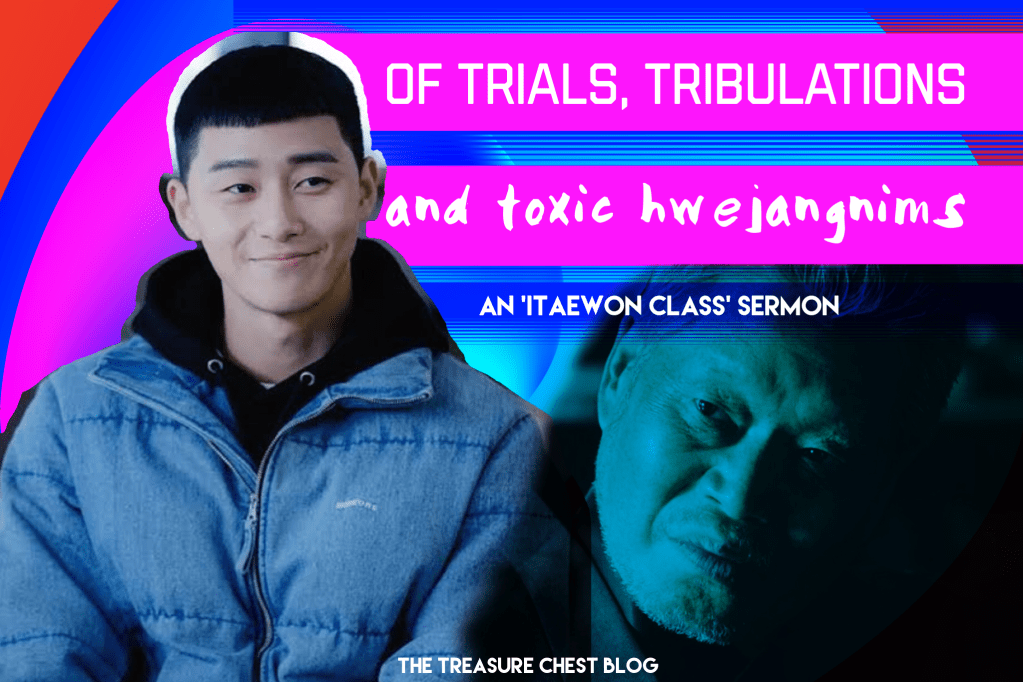
Bazakes, today’s sermon is taken from the 2020 K-Drama, Itaewon Class.
If you have not yet had the privilege, time or unction to watch Itaewon Class, a brief summary. (Source: mydramalist.com, sub-sourced from Wikipedia)
Park Sae-Ro-Yi’s (masterfully portrayed by Park Seo-Joon) life has been turned upside down after he gets expelled from school for punching a bully and his father is killed in a hit-and-run accident. Following his father’s footsteps, he opens a pub named DanBam in Itaewon and, along with his manager and staff, strive towards success and reaching greater heights.
(Might I interject here: what I am loving about K-Dramas, is how the blurbs and thumbnails give very little away of the 16+ episode journey upon which we are soon to embark, nor any indication of the emotional depths to which we, the viewers, will be dragged. Writers, I stan. Park Seo-Joon: Sir! You stay doing the things! But, I digress).
Enter the villain. Jang Dae-Hee Hwejang(nim) (let me go ahead and shorten it to Jang Hwejang) is not related by blood to the main protagonist, uri[i] Park Sae Ro Yi (PSR henceforth); a departure from the usual hwejangnim-offspring dynamic. However, from the first episode, Jang Hwejang and PSR’s paths are repeatedly entwined.
First, PSR’s father was a director at Jangga Co., the company founded by Jang Hwejang.
Second, Jang’s firstborn was the school bully upon whom PSR laid hands. PSR, on principle, refused to bow and beg for the Jang’s forgiveness; he was summarily expelled.
Thirdly, Jang Junior #1 was the driver responsible for PSR’s dad’s death. (PSR found out on the day of his dad’s funeral; he also found out that Jangga Co. tried to cover it up by paying someone else take the fall.) PSR proceeded to lay a thorough beatdown upon Jang Junior #1. Again.
That second beatdown landed PSR in prison for 2 years. Upon his release, he began working towards his dream of owning a bar, and maybe possibly perhaps turning it into a franchise. Even in that, he was dogged by Jang hwejangnim, who took an inordinate interest in PSR’s small-fry street bar (because it bothers him), and in getting PSR to bow to and beg him[ii].
Mind you, Jangga Co. was a top dog conglomerate in the food-industry. But Jang Hwejang still took it upon himself to sabotage and frustrate PSR and DanBam moves. He even admitted to one of his own employees, “I don’t know why I’m so interested in this tiny pub. I am petty in my old age. That young gun PSR bothers me.” (I may have paraphrased those words).
It may be that part of the reason Jang Hwejang was bothered by young PSR, is the fact that Jangga Co. also had its beginning as a small pub, much like DanBam.
We are not privy to the nitty-gritty of Jang Hwejang’s ascent to the top; Itaewon Class is, after all, PSR’s story. However, we do get a brief glimpse into his motivation in starting out in the food industry.
In other words, Jang Dae-Hee Hwejang had his reasons[iii].
As an impoverished adolescent, he helplessly witnessed his younger siblings dying of hunger. Thus, he overcame his tribulations, and vowed that he and his would never again experience hunger. Through no small amount of grit and determination, he got out of the gutter, and into the high-rise.
But, as the philosopher Harvey “Two-Face” Dent once said, “You either die a hero, or live long enough to see yourself become the villain”. And so it proved to be true for Jang Hwejang. His motivation eventually turned into a greed to be pre-eminent at all costs. Jang Hwejang’s survival instinct (even in the absence of a threat) left no room for integrity, to the point that he remorselessly stole another’s intellectual property (IP) to get ahead. Oh, did I mention that the IP in question belonged to Director Park, PSR’s father?
In Jang Dae-Hee’s world, Jang Dae-Hee is supreme. For him, people are at best a means to an end, and at worst, livestock. His son is not his own person, but rather an extension of him, and the future heir of Jangga Co. Maybe. His illegitimate second son is of no current use to him, so he mostly ignores him, yet still seeks to control his movements (yup, confusing). During Jang Junior No. 1’s early days, he felt a twinge of remorse, wanting to atone for the actions that led to PSR’s dad’s demise. Pappy hwejangnim, shall we say, persuaded those softer sensibilities out of him. The result was that Jang Junior #1 went the way of the psychopath. A chicken was involved.
Jang Hwejang proves the words of Abraham Lincoln to be correct: Nearly all men can stand adversity, but if you want to test a man’s character, give him power.
With his amassed power, Jang Hwejang became, in physics terms, an isolated system. And as the second law of thermodynamics states:
There is a natural tendency in any isolated system to degenerate into a disordered state.
If that ain’t a word and a sermon, y’all! This perfectly describes the consequences of Jang hwejangnim’s ‘leadership’ style.
Jang Hwejang isolated himself, holding a monopoly on power and decision-making in his company, and in his offspring’s life. He became an oligarch who craved and exerted control over those around him. One might say that his deep losses cultivated a bitterness within.
Bazakes, in the book of Hebrews, chapter 12 and verse 15, we read:
“See to it that no one falls short of the grace of God and that no bitter root grows up to cause trouble and defile many.”
The root of bitterness in Jang hwejangnim’s life defiled and brought death to those around him: death to his son’s sanity, the death of his family unit (could one even really call that loose association a family?), literal death to PSR’s father, the list goes on.
In stark contrast, we are given a front-row seat to Park Sae Royi’s responses to his own trials and tribulations.
PSR is a simple man, sturdy in his convictions, and yes, ambitious. He is wise enough to know that he does not know everything: during the prison years, PSR took time to read Jang Dae-Hee’s memoir, learning from his philosophies on business, business models, business building, etc. There is an acknowledgement of Jang Hwejang’s prowess in the food-industry game, and a humility to learn from the best, even though that person and his offspring messed up his life for no reason. (Y’all, I could wax lyrical about the kind of man that Park Sae Ro Yi is; I’m really trying to stay on track because he actually deserves his own post. Also, PARK SEO-JOON!!!!!).
PSR is loyal, almost to a fault: he rides for his staff (who have become his chosen family, after all his grief and loss). He looks beyond the surface, believes the best, hopes for the best from his people (1 Corinthians 13, somebody), and steadily loves (I seriously did not like his first love’s character, but that’s another digression).
Don’t get him wrong: he has never, not once, forgotten the role that Jang Hwejang and Jang Junior #1 played in destroying his family. But! He open-heartedly takes Jang Junior #2 (the discarded one) under his wing as one of his employees; as a little brother, really. PSR is possessed of a tenacity that sees him getting up after every hard knock, pivoting after every setback, all while refusing to bow down to bullies. What a man, what a man, what a man[iv]’[v].
In the 16-episode journey with PSR, we behold his steadiness of character. We witness his responses to life as well as the value he places on his people. He was fighting an uphill battle to the end, being betrayed along the way by some that he held dear. And yet he maintains his loyalty to his people, valuing their thoughts and ideas. Valuing their humanity.
I don’t know who, besides me, needs to hear this, but life happens. It is often far from perfect, and far from what we hoped for. Hard stuff happens, and that hard stuff will change us.
Applied to our sermon on today, the human tendency is to become disillusioned, hardened, and perhaps bitter. That is the way of the natural world. It takes a counter-natural effort to be gracious in the face of backstabbing, to show love in the face of relentless hate. It takes a death-reversing Power to wield off the inevitable despair and bitterness that come from the business of living.
It takes the Power that gave us Sunday morning’s empty tomb after the gruesome cross of Friday.
May God’s power and grace through Jesus Christ be at work within us, as we navigate our own trials and tribulations, so that no bitter root grows up to cause trouble and defile many.
May we not become a Jang Hwejang.
Amen and amen.
[i] Uri means ‘our’
[ii] I could write tomes about the theme of bowing in Itaewon Class. I can’t though, as it would give away major plot points. If you have watched Itaewon Class, holler at me in the comments and we can discuss it. Because, whew!
[iii] K-Drama writers are brilliant at giving even villains the benefit of the doubt. One deliciously written villain (there are many) is the serial killer from Suspicious Partner. Again, I stan.
[iv] Shout out to Sister Salt and Sister Pepa
[v] And might I add that Park Seo-Joon is king of portraying characters who go through the most, and come out the victor.)


Leave a Reply