
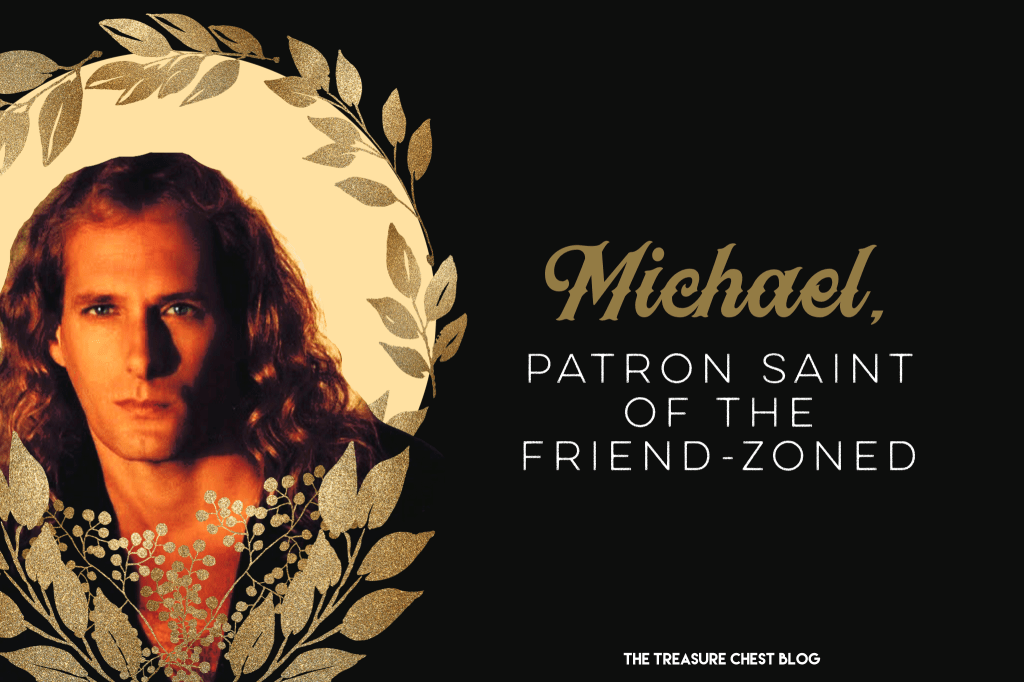
The year was 1982. The final strains of the heavy metal/disco-heavy music of the 70s had yet to resolve. A golden-haired troubadour stepped up and into his destiny, as he penned a tale of sorrow, of love lost, of hopes dashed. This tale, in song form, would become an anthem and a psalm for the broken-hearted. Nearly 40 years later, some of us, in the throes of disappointment, still clutch at our chests, and belt along with the songwriter:
“How am I supposed to live without you!?”
Yes. It is the one and only Michael Bolton of whom we speak today.
How Am I Supposed To Live Without You (HAISTLWY, if I feel like it later) is the song that introduced Michael Bolton to the world. Literally. Because our uncle’s (or maybe your crush, if you’re of a certain age) government name is Michael Bolotin. I never knew. We thank Google.
Anyways, Mr Bolotin started his recording career in 1975, later joining the hard-rock band Blackjack. Yes. Hard-rock. We age, we get soft in the middle[i]. And so, in 1982/1983, Mr Bolton started to gain traction as songwriter of the soft-rock persuasion. He penned HAISTLWY, which was recorded by fellow singer Laura Brannigan, and released in 1983 as a single[ii].
Of course, we know that in 1988, Bra’ Mike decided to record the song himself, Thanos-style[iii], for his album Soul Provider. Blowing back all of our edges with his powerfully emotive performance, Uncle Power Ballad of the House of the Forlorn was born. Henceforth known for his pipes—and when I say power-pipes[iv]—he went on to win the 1990 Grammy for Best Male Pop Vocal Performance with his song.
Brother Bolton’s rendition has resonated with the multitudes in the 33 years since its release. The earliest You-Tube upload of this song was in 2010. It currently has 166 million views, so either 166 million of us identify with this despair, or one person has had 166 million reasons to weep. I reckon the reason for the song’s never-waning popularity, Brother B’s powerful delivery aside, is that waaaay too many of us have been in our feelings after having our secret hopes dashed, like the songwriter. Let’s take a closer look at the lyrics, shall we?
The story told is thus: the protagonist goes to the person they like (their crunch, as my mom likes to say; don’t ask why my mom talks about crunches and such), over some rumours they’d heard. Incredulous, the person questions the reports of their crunch’s new love, which is not, as he has hoped all along, him. Naturally, Brother Bae is hurt within. So much so, that he proceeds to belt that iconic “How am I supposed to live without you?”[v]
The second verse goes in.
I’m too proud for cryin’, didn’t come here to break down
It’s just a dream of mine is coming to an end
And how can I blame you when I built my world around
The hope that one day we’d be so much more than friends?
Aah. Our guy had been hoping to escape The Friend Zone.
(As an aside, and if by some happenstance you have no idea what The Friend Zone is, you need only look to the Urban Dictionary: it is a conceptual place describing a situation in which one person in a mutual friendship wishes to enter into a romantic relationship with the other person, while the other does not.) Back to the dissertation.
As you remember (or don’t) from On The Theological Musings of Stevie Wonder, I believe that art reveals the mind of the artist. Our worldviews and life experiences colour what we create. A song can reveal the inner workings of the songwriter’s heart. On the other hand, good songwriters are able to tap into the imagination to create music that resonates with a wide range of listeners. I don’t know which is the case for Brother Bolton: personal experience or imagination. But this song sums up the experience of anybody who has found themselves in that dreaded Friend Zone.
Our protagonist went one step further, though. My guy, to paraphrase his own words, built his world around the hope that he and ol’girl would one day be more than friends.
Built. His. World. Around a one-day possibility? No wonder that world crumbled.
In our present culture, it often seems that romantic love is enshrined as the highest fulfilment. Our lives are deemed worthless, if we haven’t found that one other person who stamps us as loveable (I see how y’all look at us older single people). We are drawn to songs that extol the virtues of the perfect romance. Similarly, we flock to movies that portray the protagonists finding the perfect love, their soulmate.
Pause.
By way of another aside, the idea of soulmates is not biblical, but rather a hangover from Greek mythology. The poet Aristophenes (as quoted by Plato) imagined that all humans were walking around united with their other half (one entity with both male and female properties, if you catch my drift). Enter the Zeus, who split these creatures apart out of fear and jealousy, and consigned them to forever search for their, say it with me, other half. Or so the myth is told.
This idea, if not the origin of it, is still prevalent today. We want to be loved, cherished, completed by that one other person who is perfect for us. Jerry Maguire-ly. In other words, we suffer a very human tendency to idealise and potentially idolise the one we hope will complete us. (Like Uncle Mike, who built an entire planet around that desired romance).
However, and this is all real talk, mankind is a poor god. Another human, of their own strength, cannot love another perfectly. It is an unrealistic, and yet commonplace, expectation we place on each other.
(I don’t know about y’all, but I can barely get myself together on a good day. To have added on top of that, the expectation to complete somebody else? I don’t know about alla that.)
As Tim Keller puts it, “If you love anything in this world more than God, you will crush that object under the weight of your expectations”. I would add to that: you will be crushed by your disappointment. Like Brother Bolton and his crumbling world.
Yes, we are created to love and be loved, to nurture and be nurtured, to finally be complete. God created us just so. However, Perfect Love is found only in Him. This also, by His design. As to that one Love that deems us worthy to be loved, that is Jesus. Amen?
To place all our hopes for happiness in romantic love, will ultimately leave us empty. Especially once the feelings and excitement fade. Worse ke, when we do so unrequitedly, from the deep dark hole of the Friend Zone.
Bazakes, even I have been there. Many times, in fact, with bluzaring accompanied by the sounds of Ms. Mariah Carey’s “I Can’t Live”[vi]. Further details, I cannot divulge, as people are still alive and walking the face of this earth. And, quite frankly, some of my past crunches have me wondering what I was even thinking. But, at the time, I pined with my entire chest.
We thank God for growth and clarity. And the non-existence of social media in our youth.
Bazakes, let us learn from Brother Bolton’s anguish, and not put ourselves there again. Say it after me: If he don’t like me like that, then he don’t like me like that and I’m gonna keep it moving. Amen?
In fact, since Brother Bolton has taken the time and the pipes to warn us of this purgatory, I hereby nominate him as The Patron Saint[vii] of the Friend-Zoned. He has gone through the fire (of the Zone), and has come out refined on the other side. In a song-writing sense. In 1991, nearly a decade after his world-crumbling tale of woe, he then blessed us with this benediction:
When love puts you through the fire
When love puts you to the test
Nothing cures a broken heart like
Time, love and tenderness
When you think your world is over
Baby just remember this
Nothing heals a broken heart like
Time, love and tenderness
Now, I wonder where we can all find that kind of love and tenderness? Most assuredly, with The One who holds time itself in His Hand.
Let the church say.
Amen again.
Copyright reserved. Gugulethu Mhlanga 2021.
[i] Philosopher Paul Simon’s words from Call Me Al (Graceland album).
[ii] Interestingly, HAISTLWY was initially written for the Australian group Air Supply.
[iii] “Fine, I’ll just have to do this myself.”-Thanos, MCU end-credit scene number gazillion
[iv] Bother Bolton even held his own on the same stage as Pavarotti, belting Nessun Dorma. You Tube it, you shall not be disappointed.
[v] Conversationally, I would hope that this is more pleading than yelling, but you never know.
[vi] Aah, I’ll never forget my first crunch; foine young man I met at the playground in Chapel Hill. I was 9, he was 13. And he liked me back, but I never found out until it was too late and his family had moved to Michigan (you may weep with me, fam). Ms Carey helped me through some dark, dark times back in 1994. Also, I was way too young for such heartfelt emotions.
[vii] Saint is used in a satirical, not literal sense. Don’t call the theological po-po on me. Michael Bolton is yet very much alive. Although his previously flowing golden locks did once confer a rather beatific appearance.
 The Treasure Chest Blog
Leave a comment