
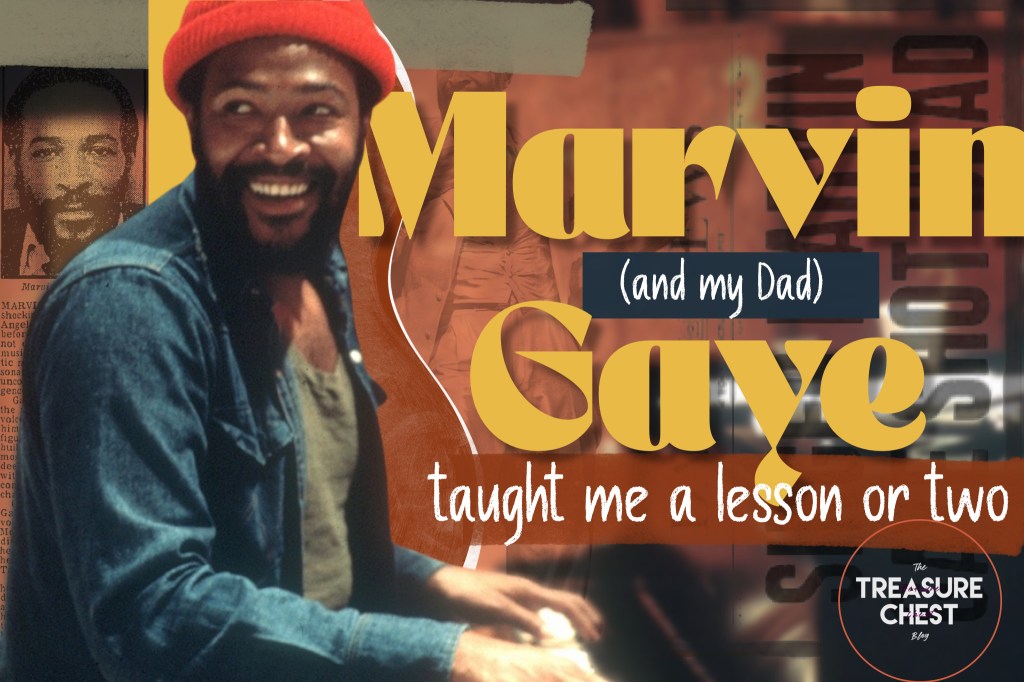
We were riding along with the Pater Familias one evening. By we, I mean the Big Sis and I. Anyways, we were riding along with Dad in a forest green Camry. (The Camry places the time of this story in the late 1900s. The colour thereof has no specific relevance for this narrative.)
Back in the day, we used to have what was known as a CD player in the car radio[i]. The Camry was extra fancy: it had a 6-CD shuttle system. I miss those days.
Dad had recently added, to the 6-CD rotation, a live recording of a Marvin Gaye concert. This CD formed the soundtrack of this particular trip home.
(I have since tried to figure out which album it was. Multiple moves, and Dad’s propensity for being sneakily robbed by the strangers to whom he gave car-rides, mean that I have long since then lost track of that CD’s location. My closest guess is that it was the 1983 Cincinnati concert. This date is important, given what would happen less than a year thereafter.)
As most artists tend to do during their live recordings, Uncle Marvin interspersed the music with little anecdotes, introducing some songs, interacting with the energetic crowd, etcetera. For instance, he introduced the song “Joy”, by revealing that it was inspired by his father, Marvin Gay Sr. (More about that later.)
Later, Marvin Jr. launched into another soliloquy about how he had his start in the church, and how he was planning on going back to God, the church, or maybe recording a gospel album (my recollection on this particular utterance may be incorrect; I also cannot remember at which point in the recording he may have said this. Maybe “God is My Friend”?).
But I remember this: Dad turned down the volume knob soon after. He cleared his throat. His forehead crumpled, as it always did when he was about to utter one of his profound life lessons. The Big Sis and I rolled our eyes over to each other. Here we go…
We were teenagers.
“You know,” he began. “Marvin Gaye kept saying he wanted to get back to the church. He never made that gospel album. In fact, he died a few months later. So, you see…you never know when your time is up.” (Subtext: get right or get left)
In the back seat, adolescent eyes continued to roll.
The volume knob was turned back up. The shuffle function brought up the next song, heralded by Marvin Jr’s signature howl. “Get up get up get up get up… Wake up wake up wake up wake up”.
(By the by, the video of that recording is something to behold. Marvin Jr was performing in his black, satin ensemble: pyjama bottoms and a robe, no shirt. Halfway into Sexual Healing, the robe came off. He gyrated, teasing a “no pyjamas” reveal. Thankfully, he stopped. “I ain’t Prince” was his reason. Cocaine is a terrible drug, bazakes.[ii])
On April 1, 1984, a few months after that October 1983 recording, Marvin Gaye’s life came to an end. At the hands of his own father, the Pentecostal minister Marvin Pentz Gay, Sr.
And here is where a backstory is needed. Stay with me.
(Also, my condolences to those who had to live in the aftermath of this implosion. This was not just a piece of entertainment news; it was a moment that forever changed their lives, even though it was more than 40 years ago now.)
Marvin Sr, in a nutshell, was an authoritarian gent. A man of the cloth, and some spirits (of the ethylated kind), who regularly beat his 4 children. There was another child, born outside of his marriage with Ms Alberta Gay. At some later point, he developed frank alcoholism, and a cross-dressing habit.
(We, the people, have been needing therapy. Yho!)
Anyways, Marvin Sr was a staunch…something, for all his private proclivities. His children felt the full effects of his staunch authoritarianism. Mandatory church attendance, strict observance of Sabbath, beatings for wrong answers to Bible quizzes, beatings for the bed-wetting that followed, beatings for leaving his hairbrush in the wrong place, beatings for being a minute late from school.
All in all, he was a joy to be around.
The father-son relationship between Senior and Junior was particularly contentious, by all accounts. Following a brief exhibition of joy at the birth of his namesake son, Marvin Sr soon began to resent the attention the boy received from his mother, Ms Alberta. The accolades young Marvin received for his prodigious singing talent within the church, did not help in mending their fractured bond.
Marvin Jr said in an interview later, that he sang to gain his father’s love and approval. He hated his father, yet wanted to please him, all at once. Marvin Sr, in turn, resented his son’s existence, but tolerated his singing, as long as “it remained liturgical” (Source: Wikipedia).
It didn’t.
Marvin Jr escaped his father’s house (literally and figuratively) by enlisting in the army. He eventually found his way to a record-deal with Motown. Fame and prosperity soon followed. The whole thing fermented Marvin Sr’s disapproval. His son had left the church and God, and was dancing (and singing) with the devil. For years thereafter, the two could not co-exist in the same room peacefully. Or at all, to hear it told.
Marvin Jr’s upbringing clung to him, though. According to Christopher Goddard[iii], in a piece written for the LA Times, ‘His songs married carnality and spirituality, with an echo of the little boy singing in the gospel choir of his father’s church.’
Marvin Jr, interestingly, was self-aware. He knew that his career motivation, his crooning for and wooing of the masses, was to make up for not receiving that elusive approval from Marvin Sr. Oh, and he got the adoration of the ladies. In overflow.
But.
Their praise and adulation did not stop the depression and suicidal ideation Marvin Jr struggled with. It did nothing to stem his substance abuse.
Fast forward to the 80s.
Marvin Jr eventually moved back in with his parents. Or rather: he bought a house, which he then shared with the parentals. The combination of his mental health struggles and substance use caused him to gradually lose touch with reality/rationality/prudent decision-making.
He was beset with paranoia, convinced that someone was out to get him. So, he bought his father a revolver for Christmas (1983). You know, to help him (Junior) ward off any intruders who might be out for his (Junior’s) blood.
(His fear of these murderous enemies was suspended long enough for his suppliers to keep supplying that stuff. He made sure to keep his door open for that supply. Drugs. Don’t do them.)
April 1, 1984.
Marvin Sr (alcoholic), gets into an argument with (read: starts verbally abusing) his wife Ms Alberta, over a misplaced insurance policy. Marvin Jr (traces of cocaine and PCP in his bloodstream at autopsy), pushes back against Marvin Sr. Repeatedly. With great, perhaps drug-fuelled, vigour. A strapping 44-year-old against a 69-year-old gent/chronic abuser.
At this point, his oft repeated phrase “I brought you into this world. I can take you out!” must have crossed Marvin Sr’s mind. Choices were made. He fetched the revolver that Marvin Jr had gifted him back in December.
He shot Marvin Jr twice.
And that was the end of Marvin Jr’s life.
He never did receive his father’s approval.
Marvin Jr’s death was a tragedy, in the most profound sense[iv].
Between Dad’s Camry-sermon, and my own research, I gleaned 2 lessons from retellings of Uncle Marvin’s life and death.
Firstly, the sins of the father really do get visited on the children. Not just visited. Copied, multiplied, and amplified. Unless the Power that turns death to life, intervenes.
Both Marvins battled serious demons. Marvin Sr built an entire career (and crafted the appearance of righteousness) in the church. But he lived FAAAAAAAAARRRR from the life-altering reality of the redemptive power of the Gospel[v].
Marvin Sr imposed control on the family he was meant to lead. He openly hated those he was called to love. He abused those he was meant to cherish. He had a form of godliness, but denied the power thereof.
That scares me. For myself[vi].
Marvin Jr, in turn, grew up in an environment where the only model he had for the Heavenly Father’s love, was his earthly father’s love… the lack thereof. The lie that was imprinted on young Marvin Jr’s heart, was that love is something earned through performance. His soul knew there was something better, but his earthly father’s shadow loomed so great in the church building, that it was near impossible for him to really see the tenderness in his heavenly Father’s gaze. To drugs and a dissolute lifestyle he turned instead.
And his father killed him for the mess that Marvin Sr himself had cultivated.
Secondly, Dad’s point did settle in my mind, rolling eyes and all: we humans make many plans for a future we are not guaranteed. One day, you’ll be at the height of your life and career, planning for a thousand tomorrows, only to have those days sealed. Death asks for no permission. It has no herald. It arrives swiftly.
So, while we’re living, we must LIVE, and not court death. We must not delay the choices that our souls know are right.
Let the church say.
© Copyright reserved. Gugulethu Mhlanga. 2026.
[i] Askies to ama2K. You will never know.
[ii] His bandmates, when interviewed later, attest to the fact that Marvin was fighting, and losing to, a drug addiction.
[iii] Inside the tragedy that silenced a soul legend: Marvin Gaye’s last fight with his father. The Los Angeles Times. August 20. 2025.
[iv] Shades of Greek mythology kind of tragedy.
[v] I could not find much about his later years, and whether redemption found him.
[vi] Along with the Scripture that says: not all who call me Lord, Lord will enter the kingdom of heaven. Matthew 7:21


Leave a Reply